How do you feel about art as a form of competition?
Art can be taken as both competitive and not competitive. Depending on your personality and how you take things as, that is what art is to you. Throughout my life, I liked to create art out of fun and talent. I drew whenever I wanted and whatever I wanted. That continued up until high school where I found out that what I wanted to do in the future is make art. I wanted to go to an art college and become a well known artist or have a job that I will enjoy, having to do with my interests. But to do that, I had compete with other students. I had to set up a portfolio of the best pieces of art I have created, present them to the college admissions and have them compare my art to other peoples' art to see how serious I am and decide whether or not I am accepted to this private college or not. I actually did well and was accepted right on the spot. Only issue was that this college was very expensive and was very serious and competitive with their art. Personally, I'm not a competitive person at all. So what I think art should be is just creativity you can create freely and out of lesiure.
In today's society, art has become extremely competitive because of the scarceness of job opportunities and the fact that we are competing with other people who want the same thing.
Monday, May 9, 2011

I resist defining art because…
All I know about art is that it consists of different categories, painting, sculpture, music, performing, acting, dancing, drawing, singing, etc… Many philosophers have spent years trying to find a definition of what art is. Plato has defined art as a goal of imitating the everyday reality. But then there is John Dewey, who believes that art is everything, and David Hume, who believes that art is based on one’s opinion and taste and that only qualified people can judge what art is. Art is undefinable. No matter what, there is an exception for something to be considered a piece of art, therefore, is the reason why the definition changes every time. Not only that, everyone has a different definition for art. For example, Arthur Danto believes that art can only be distinguished by people who are dedicated to art and are a part of the art world.
Thursday, May 5, 2011
Art Philosophers Summaries:
Throughout the semester, I've had trouble trying to differentiate between all of the Philosophers we have studied. To help me, I pretty much made a list and summarized some of the art philosophers as best as possible.
Plato- He believed that the goal of art is to imitate the everyday reality.
Aristotle- Art is a way of representing. (He referred most of his ideas to poetry) "emphasis on the possible"
David Hume- Art is based on one's taste. Only qualified people can judge what art is.
Tolstoy- "Through the use of such devices as color, sound and movement, art communicates to its audience a feeling or emotion that the artist has previously experienced." He raises the question of "What is Art?" and in his definition, he says that art is communication, pleasure, statement and activity.
Freud- Art is expressing feelings, thoughts, emotions and dreams that aren't acceptable to society, yet making it pleasurable for viewers to see.
Collingwood- He believes that it is good to express your feelings and that you have to use your imagination in order to create art.
John Dewey- "art should not be conceived as a radically distinct aspect of human life."
"art results when the desire to create an object whose perceptible properties will yield immediate satisfaction controls the process of its production."
Martin Heidegger- Defines art as truth
John Dewey- People tend to ignore nature and not consider it as art (aesthetic emotion/satisfaction). The whole point of science is art.
Plato- He believed that the goal of art is to imitate the everyday reality.
Aristotle- Art is a way of representing. (He referred most of his ideas to poetry) "emphasis on the possible"
David Hume- Art is based on one's taste. Only qualified people can judge what art is.
Tolstoy- "Through the use of such devices as color, sound and movement, art communicates to its audience a feeling or emotion that the artist has previously experienced." He raises the question of "What is Art?" and in his definition, he says that art is communication, pleasure, statement and activity.
Freud- Art is expressing feelings, thoughts, emotions and dreams that aren't acceptable to society, yet making it pleasurable for viewers to see.
Collingwood- He believes that it is good to express your feelings and that you have to use your imagination in order to create art.
John Dewey- "art should not be conceived as a radically distinct aspect of human life."
"art results when the desire to create an object whose perceptible properties will yield immediate satisfaction controls the process of its production."
Martin Heidegger- Defines art as truth
John Dewey- People tend to ignore nature and not consider it as art (aesthetic emotion/satisfaction). The whole point of science is art.
Defining an Artist; A Partial Response to Sean's blog:
As a little kid, everyone knew me for my talent of drawing. They called me an artist. But the thing is, I never really thought I was one. I thought you had to be very good in whatever media you are good at and have a lot of money. Apparently, this is a bad assumption to make. Anyone can be an artist according to what George Dickie says. But is that true?
As of today, I don't consider myself an artist, though I accept the title as the artist of my pieces of work. The thing is that I can create art and make beautiful pieces of work but I feel I have to be very dedicated and put a lot of effort into it. I just make art and sometimes hardly put any effort into it at all.
Compare this to Leonardo Da Vinci and his art work. He actually put his all into his art work, making experiments and creating beautiful artwork that no one can ever duplicate using the exact tools he used in his paintings.
If a little kid can qualify as an artist, wouldn't that be degrading to the art world? After all, a little kid can't become a doctor until he/she gets a PhD. Isn't there some sort of level a child must reach to be considered an artist? If there is, how would the people know?
As of today, I don't consider myself an artist, though I accept the title as the artist of my pieces of work. The thing is that I can create art and make beautiful pieces of work but I feel I have to be very dedicated and put a lot of effort into it. I just make art and sometimes hardly put any effort into it at all.
Compare this to Leonardo Da Vinci and his art work. He actually put his all into his art work, making experiments and creating beautiful artwork that no one can ever duplicate using the exact tools he used in his paintings.
If a little kid can qualify as an artist, wouldn't that be degrading to the art world? After all, a little kid can't become a doctor until he/she gets a PhD. Isn't there some sort of level a child must reach to be considered an artist? If there is, how would the people know?
Monday, May 2, 2011
Response to Kurt's Blog:
Do you believe video games deserve the title of "Art"?
I believe that video games are considered art. The designer of the video game has to create designs for the characters, setting, theme, background, etc. The fact that this form of art is animated and that you can make these characters or things move and make them achieve goals (such as collecting coins in the old game, Mario). These extra things pretty much means that these artists went overboard to the point that people can control it and can change the whole story-line of the piece of art.
Try comparing a painting of car like this:
 And compare it to a video game that has a bunch of cars like these that you can race and move around, seeing it from all different angles, such as the one video game that is found in almost every arcade:
Fast and Furious.
Video games include computer graphic art, so therefore, it is.
I believe that video games are considered art. The designer of the video game has to create designs for the characters, setting, theme, background, etc. The fact that this form of art is animated and that you can make these characters or things move and make them achieve goals (such as collecting coins in the old game, Mario). These extra things pretty much means that these artists went overboard to the point that people can control it and can change the whole story-line of the piece of art.
Try comparing a painting of car like this:

Fast and Furious.
Video games include computer graphic art, so therefore, it is.
Monday, April 25, 2011
Art Museum VS Concert
The other day, we had a class discussion about fetishism and satisfaction. We also compared how pleasing a concert performance is to an art museum. One argument was that going to a concert is more pleasing because it is more like a once in a life time thing and it would be something you can savior in your memories. Another argument was that you can lose interest after a while of going to the same art museum over and over again, after all, the museum will have the same exhibits and art work. Here's what I think:
It all depends on your preference and what you like better. For instance, I'm an art major but I don't like looking at other people's art work over and over again, everyday, unless it's something I like a lot, like garbage art. But I also like going to concerts. The problem with comparing these two ideas is that concerts cant really be performed every single day in the same spot and each performance would be different each time.
It all depends on your preference and what you like better. For instance, I'm an art major but I don't like looking at other people's art work over and over again, everyday, unless it's something I like a lot, like garbage art. But I also like going to concerts. The problem with comparing these two ideas is that concerts cant really be performed every single day in the same spot and each performance would be different each time.
Sunday, April 3, 2011
What is Beauty?
What I think is beautiful will be different from what you think is beautiful.
Here's what I think is beautiful:
Question: Depending on how we describe beauty, does it matter how we were raised that answers why we have differences on the definition of beauty?
Here's what I think is beautiful:
- the colors of the clouds and the sky as the sun comes up into view to signify that it is morning as the birds just start to chirp and the air is starting to become warm from the sun's rays
- the ocean waves crashing and lapping over the softest grains of sand at the beach
- the fresh looking customized nike shoes I had just found online
- the sound of Whitney Houston's voice as she sings
- the ripe rasberries still dangling from the rasberry bushes
- the picture of my parents' wedding day where my mom wore a beautiful white wedding gown, smiling into the eyes of my dad in his black tuxedo.
- the velvety red petals folded and curled together, forming a rose with sharp thorns pricking out of the stem.
- the 5 star restaurant food I see on T.V. were they decorate the food to extreme elegance, too perfect to eat.

Question: Depending on how we describe beauty, does it matter how we were raised that answers why we have differences on the definition of beauty?
Friday, April 1, 2011
Response to Kim's blog:
"Do you think Tolstoy and Goodman have compatible theories about art?"
No I don't think so. Tolstoy is an art philosopher who believes that a good piece of art would have to express an emotion. This is so that people can have a connection they can both share with art. The connection they have with emotion is something everyone can experience. He explains his theory that "through the use of such devices as color, sound, and movement, art communicates to its audience a feeling or emotion that the artist has previously experienced."
What Tolstoy believes the best art is what makes one feel tainted by whatever feeling or emotion the work of art is trying to convey to art viewers. Art that effects its people who take in the view of the piece of art and receive the most emotion from it is what Tolstoy considers true art. Where as for Goodman, he uses the question, "when is art?" rather than the usual "what is art?". So far, the two philosophers may seem to have the same ideas, but Goodman believes that the meaning of the art doesn't matter, but only how the art was made. According to Tolstoy, every piece of art has emotion, which means that every piece of art has meaning. So that brings out the differences between Tolstoy and Goodman.No I don't think so. Tolstoy is an art philosopher who believes that a good piece of art would have to express an emotion. This is so that people can have a connection they can both share with art. The connection they have with emotion is something everyone can experience. He explains his theory that "through the use of such devices as color, sound, and movement, art communicates to its audience a feeling or emotion that the artist has previously experienced."
Question: Since there are the questions, "What is art?""When is art?" is there another question you can use in art philosophy?
Tuesday, March 29, 2011
Response to Natalie's blog:
"Is it possible for pieces to be better than others?"
It depends. I mean, there are so many levels of art and then you have to also depict what you mean by better. One piece of art can better show cubism, for example, and then you'd think of Pablo Picasso and his art works. And then there art other things that you can describe for best, such as best painting, sculpture, act, music, dance, etc.
It depends. I mean, there are so many levels of art and then you have to also depict what you mean by better. One piece of art can better show cubism, for example, and then you'd think of Pablo Picasso and his art works. And then there art other things that you can describe for best, such as best painting, sculpture, act, music, dance, etc.
Backtracking to Hume
So, Hume states that we can't truely judge art unless we are clean/pure, meaning not drunk, high, upset, happy, sad, or anything. So what does that leave us at? What emotion do we have left and what would we think of and how would we think if we aren't influenced by anything? We are influenced by everything. So just trying to think of how we would act and be if everything in our lives never affected us seems a bit impossible to imagine.
What would we be like if we weren't influenced or effected by anything?
What would we be like if we weren't influenced or effected by anything?
Coffee Art?
After watching the movie called, "The Green Hornet," I suddenly was in awe of the way people make their coffee. I picture it as some form of art, knowing that there isn't a very clear deffinition of what art is and all. After looking up some images of coffee art on the internet, I saw that with a lot of practice, you can pretty much create any image in simply something you drink when you wake up in the morning.
You can take a cup of coffee like this:


You can take a cup of coffee like this:

and turn it into something like this:

or this:

So here's my question.... Because coffee is drinkable and you can create art with it, shouldn't it be more known and attention grabbing since it doesn't last as long as a painting would?
Monday, March 28, 2011
Why does Weitz say that art’s “openness” makes a definition impossible?:
What Morris Weitz means is that Art continually evolves, mixing up the categories in art and moving them around so much that it disrupts other categories that he believes it is impossible to define art in such a way he believes all other word can be directly defined. Because of the fact that art has no boundaries and is considered a practice make the definition of art indefinable. There are also just so many varieties, parts, sections and exceptions in art for it to be described in a coherent way. As art changes throughout evolution, the definition also changes along with it. Art can be looked at in many ways, as what Morris Weitz comments about L. Wittgenstein's essay, art could be looked at as a game.
Weitz mentions how although art has many categories, such as "'tragedy,' 'comedy,' 'painting,' 'opra,' etc." Only thing is that art has to fit perfectly into that category description, other wise, there would have to be a new category made in art. You can compare art to a family for example, as Weitz tries to explain. For every family member, one person can have brown hair, blue eyes, and freckles. This family member might look similar to another family member but have different resemblances. For example, family member number one might have straight hair and family member number two might have curly hair. This is the way Morris Weitz thinks of how words are defined. He believes that words can seem like they mean the same thing but have a distinct definition that makes the words different from each other. And that is why he believes art is indefinable.
Weitz mentions how although art has many categories, such as "'tragedy,' 'comedy,' 'painting,' 'opra,' etc." Only thing is that art has to fit perfectly into that category description, other wise, there would have to be a new category made in art. You can compare art to a family for example, as Weitz tries to explain. For every family member, one person can have brown hair, blue eyes, and freckles. This family member might look similar to another family member but have different resemblances. For example, family member number one might have straight hair and family member number two might have curly hair. This is the way Morris Weitz thinks of how words are defined. He believes that words can seem like they mean the same thing but have a distinct definition that makes the words different from each other. And that is why he believes art is indefinable.
Shouldn't there be certain principles that the definition of art should follow? If there are, what are they?
Hume's Philosophy:
We could only judge what good and bad art is through human nature, through whatever we see fit that brings pleasure to our eyes. The difficulty is that one's opinion can change according to what they feed and what their emotions are. If one were, for example, to have a fever, that person would have a much different opinion if he or she were to be well. He or she might choose for example, tea rather than coffee when sich with a fever and coffee over tea after a night of partying with a hangover. Small things can affect one's opinions. If someone were in a bad mood, he or she would choose the most gloomy, dark, and/or gruesome paiting. If someone were to be in a good mood, he or she would choose the most cheerful, happy and bright painting.
Why do our emotions effect our opinions so easily?
Why do our emotions effect our opinions so easily?
Sunday, March 27, 2011
Something I Found:
Click on the link below to see what I had found. It's mostly just an article on art taken to the streets and turning a place into something different, something people can play around with (especially with a camera). He turns a peaceful setting into something extreme or disruptive, yet also playing with our minds. Just imagine stepping out of your house or apartment and seeing this outside.
http://www.dailymail.co.uk/news/worldnews/article-1153004/Mind-crevasse-The-amazing-3D-pavement-art-pedestrians-edge.html

http://www.dailymail.co.uk/news/worldnews/article-1153004/Mind-crevasse-The-amazing-3D-pavement-art-pedestrians-edge.html

Monday, March 7, 2011
Response to Brycen's blog:
If photography is to be considered art, then is real life also art? Is nature and everything around us also art?
Real-life can be art, for example, dancing and acting, if that is what Brycen means. And to answer his other question, yes it can be. As Thomas E. Wartenberg has explained in his essays, art can pretty much be anything that is pleasing to ones' eyes.

For instance, one can find a spider web and find it pleasing (thus, similar to what John Dewey has stated about whether or not animals could make art), and consider it art.
If you look at the world through a photographer's eye, anything can be a possibility of becoming a piece of art depending on how one looks at it. Taking a picture of it on a Kodak or Nikon or any other type of camera only makes one feel like it's more official as a work of art. You don't have to look through a pair of lenses to consider something you see a work of art.
Real-life can be art, for example, dancing and acting, if that is what Brycen means. And to answer his other question, yes it can be. As Thomas E. Wartenberg has explained in his essays, art can pretty much be anything that is pleasing to ones' eyes.

For instance, one can find a spider web and find it pleasing (thus, similar to what John Dewey has stated about whether or not animals could make art), and consider it art.
If you look at the world through a photographer's eye, anything can be a possibility of becoming a piece of art depending on how one looks at it. Taking a picture of it on a Kodak or Nikon or any other type of camera only makes one feel like it's more official as a work of art. You don't have to look through a pair of lenses to consider something you see a work of art.
Sunday, March 6, 2011
Response to Gina's question:
Is it better to repress our emotions for the sake of societal standards, or should we express ourselves freely through the medium of art?
Well, we already express our explicit emotions in art as of now along with the past, and we do repress almost all of our emotions for the sake of society. But to choose which is better, I'd say, leave it the way it is now. People are very fragile beings that are very opinionated and prefer explicit things to be censored. I'll have to agree with that, after all, there are younger people/children who aren't mature enough, nor old enough, to hear or know of such emotions. It helps the way children grow up into when they become older. Those who are exposed to such explicitness would experience, for example, violence early in life.
To express our feelings and emotions in art is more of a safer way of expressing it than to just to tell people about it (then again that's why we have therapists to talk to about it). Through art, if you choose abstract art, you can hide those explicit thoughts in the painting or drawing or whatever art form it is you choose. So either way, we use art as a form of escape to express our hidden emotions.
Well, we already express our explicit emotions in art as of now along with the past, and we do repress almost all of our emotions for the sake of society. But to choose which is better, I'd say, leave it the way it is now. People are very fragile beings that are very opinionated and prefer explicit things to be censored. I'll have to agree with that, after all, there are younger people/children who aren't mature enough, nor old enough, to hear or know of such emotions. It helps the way children grow up into when they become older. Those who are exposed to such explicitness would experience, for example, violence early in life.
To express our feelings and emotions in art is more of a safer way of expressing it than to just to tell people about it (then again that's why we have therapists to talk to about it). Through art, if you choose abstract art, you can hide those explicit thoughts in the painting or drawing or whatever art form it is you choose. So either way, we use art as a form of escape to express our hidden emotions.
Wednesday, March 2, 2011
Response to Joshua's question
Will art ever go extinct?:
I believe that art is forever evolving. Honestly, I don't think art can ever go extinct. If it does, how would art become extinct and how would the world look like for art to become extinct?
I believe that art is forever evolving. Honestly, I don't think art can ever go extinct. If it does, how would art become extinct and how would the world look like for art to become extinct?
Tuesday, March 1, 2011
Art of Scarification:
Looking at my friend's new tattoo, I see how raw it looks and how much it hurt in the process. Another friend asked her if she bled a lot, which was the first time I've ever heard someone ask such a question. I never knew you could bleed when you got a tattoo. And thinking about it now, how much I badly want one I wonder if, as horrible and disgusting as it sounds, pain can be a part of art, or at least the thought of it.

Knowing this and how people are taking art to the next level I want to ask:
Does pain make art more interesting?
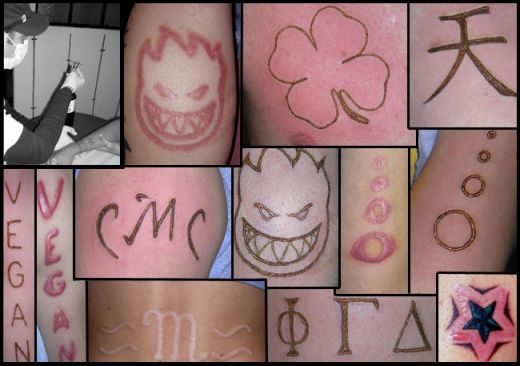

There's also people that brand themselves (they prefer to use the term "scarification"). This type of body art used to be the rite of passage in the ancient times, where when one goes through this process, they become known as a real man or woman. Not to be gruesome or anything, this topic interests me. When you look as someone's tattoo, you usually look at the size first. And the first question everyone asks first is usually "Did it hurt?" And for me, I believe that the coolest looking tattoo is always the most largest and most painful-looking tattoo (on their back for example). And the thought of knowing that this person went through all that pain to get that tattoo done and finished on their very own skin makes it even more worth while to look at.
One form of body art that gives me the creeps of thinking about is "scarification." Like tatooing, scarification is one of the oldest forms of body art many cultures use as a rite of passage. But now, it is becoming one of the popular forms of body art, just like tatooing, piercing, etc...
Knowing this and how people are taking art to the next level I want to ask:
Does pain make art more interesting?
Beautifying Natural Art
After reading John Dewey's essay, I realized how true he is about how people don't think of organic objects and/or things as art. Currently, I am taking a Great Monuments of Art II class that is mostly focused on Navajo Folk Art. I often tend to find this subject dry during lectures about rugs that the Navajos have made, Navajo sand-paintings, and such.
 We do not really think of objects that are beautiful (creative) and also useful are considered art. As Dewey says in his essay, "A conception of fine art that sets out from its connection with discovered qualities of ordinary experience will be able to indicate the factors and forces that favor the normal development of common human activities into matters of artistic value."
We have houses, or apartments, that are considered our shelters, yet we also keep it clean and/or modern and just the way we think houses should be in our eyes. We would never really think of our houses as a piece of art. Sure, keeping the house clean is in a way a form of survival in order for it to be inhabitable, but we add extra touches to it. Those extra touches we add to it include windows curtains, rugs/carpet/wood flooring, doors, pictures/paintings/wall decoration, etc....
 These extra touches are not important to our everyday lives, for we can just survive in caves and dirt floor. Instead, we choose to satisfy ourselves with unnecessary appliances and such, using what we know about art and color coordination, we add a bit of beauty and art into our shelters we call home.

We have houses, or apartments, that are considered our shelters, yet we also keep it clean and/or modern and just the way we think houses should be in our eyes. We would never really think of our houses as a piece of art. Sure, keeping the house clean is in a way a form of survival in order for it to be inhabitable, but we add extra touches to it. Those extra touches we add to it include windows curtains, rugs/carpet/wood flooring, doors, pictures/paintings/wall decoration, etc....

Subscribe to:
Posts (Atom)